
How Many New Patients Should a Med Spa Realistically Expect From SEO in 90 Days?

Most med spas should expect early visibility gains in 90 days, not a flood of new patients. SEO on a new or under-optimized site typically starts converting into real booked appointments somewhere between month four and month six, once Google has had time to trust the changes.
That timeline frustrates owners who were sold on faster numbers. It's the same expectations gap we cover in why aestheticians lose clients online, just showing up as a timeline problem instead of a visibility problem.
Key Takeaways
- 90 days is enough time to see ranking movement and traffic growth, but rarely enough time to see a large volume of new booked patients.
- The realistic patient-volume timeline runs 4 to 6 months for most local service pages, longer in competitive metro markets.
- A site with zero prior SEO work sees a different 90-day curve than a site with an existing content and backlink base.
- Tracking rankings and organic traffic in the first 90 days is a better health check than tracking patient count alone.
- Local pack visibility (Google Business Profile placement) often moves faster than organic blog rankings and can produce earlier patient volume.
What Actually Happens to a Med Spa's SEO in the First 90 Days?
The first 90 days are mostly about Google re-evaluating the site, not patients finding it. New or updated pages need to be crawled, indexed, and then tested against competing pages before rankings settle.
That process alone can take 4 to 8 weeks before any movement shows up in rank tracking.
Once movement starts, it's usually gradual: a page moves from position 40 to position 18, then from 18 to 9, over successive weeks. That's real progress, but position 9 for a competitive term like "Botox near me" still isn't generating meaningful call or booking volume.
The patient volume tends to show up once a page holds a top-5 position consistently, which is rarely a 90-day outcome for a competitive keyword in a mid-size or large metro market.
Why Do SEO Agencies Sometimes Promise Faster Results Than This?
Some agencies quote early wins because early wins are real, they're just not the same thing as new patients. Traffic increases, keyword rankings climbing, and improved Google Business Profile visibility can all happen inside 90 days and are worth reporting honestly.
The problem is when those metrics get framed as patient-volume promises rather than what they actually are: leading indicators.
A practice seeing a 40% increase in organic sessions in month three should treat that as a sign the strategy is working, not as a stand-in for booked appointments.
The American Med Spa Association has noted the same gap in owner expectations across the med spa industry broadly: marketing metrics and revenue metrics move on different clocks, and conflating them sets owners up to judge a working strategy as a failing one.
Does a Brand-New Website Move Slower Than an Established One?
Yes, and the gap is significant. A domain with no prior content, no backlinks, and no established trust with Google is starting from zero, sometimes called the "sandbox" effect informally in SEO circles, where new sites see suppressed rankings for the first several months regardless of content quality.
An existing site with a few years of published content and some earned backlinks can see 90-day movement that a brand-new site simply can't match, because Google already has a trust baseline to build on.
This is one of the biggest variables that gets left out of blanket 90-day promises: the starting point matters as much as the work done during the 90 days.
It's a similar foundation problem to the one covered in our med spa marketing guide for 2026: strategy quality matters, but so does what a practice is starting from.
What Should a Med Spa Actually Measure at the 90-Day Mark?
Keyword rank position for target procedure and location terms, organic session growth compared to the prior quarter, and Google Business Profile impressions and calls are the three metrics that reliably move in 90 days and reflect real progress.
Booked-appointment attribution to organic search is the metric that lags behind all three.
A practice can reasonably expect double-digit percentage growth in organic sessions by month three if the technical foundation was sound going in.
Direct patient bookings attributable to that traffic growth typically follow a quarter or two later, once rankings stabilize in positions patients actually click.
How Does Market Competition Change the Timeline?
A med spa in a smaller metro with fewer competing practices can see patient-generating rankings faster than one in a saturated market like Los Angeles or Miami, where dozens of practices are competing for the same procedure and location keywords.
Competitive density is one of the single biggest factors in how fast 90 days turns into visible patient volume, more than most owners initially expect.
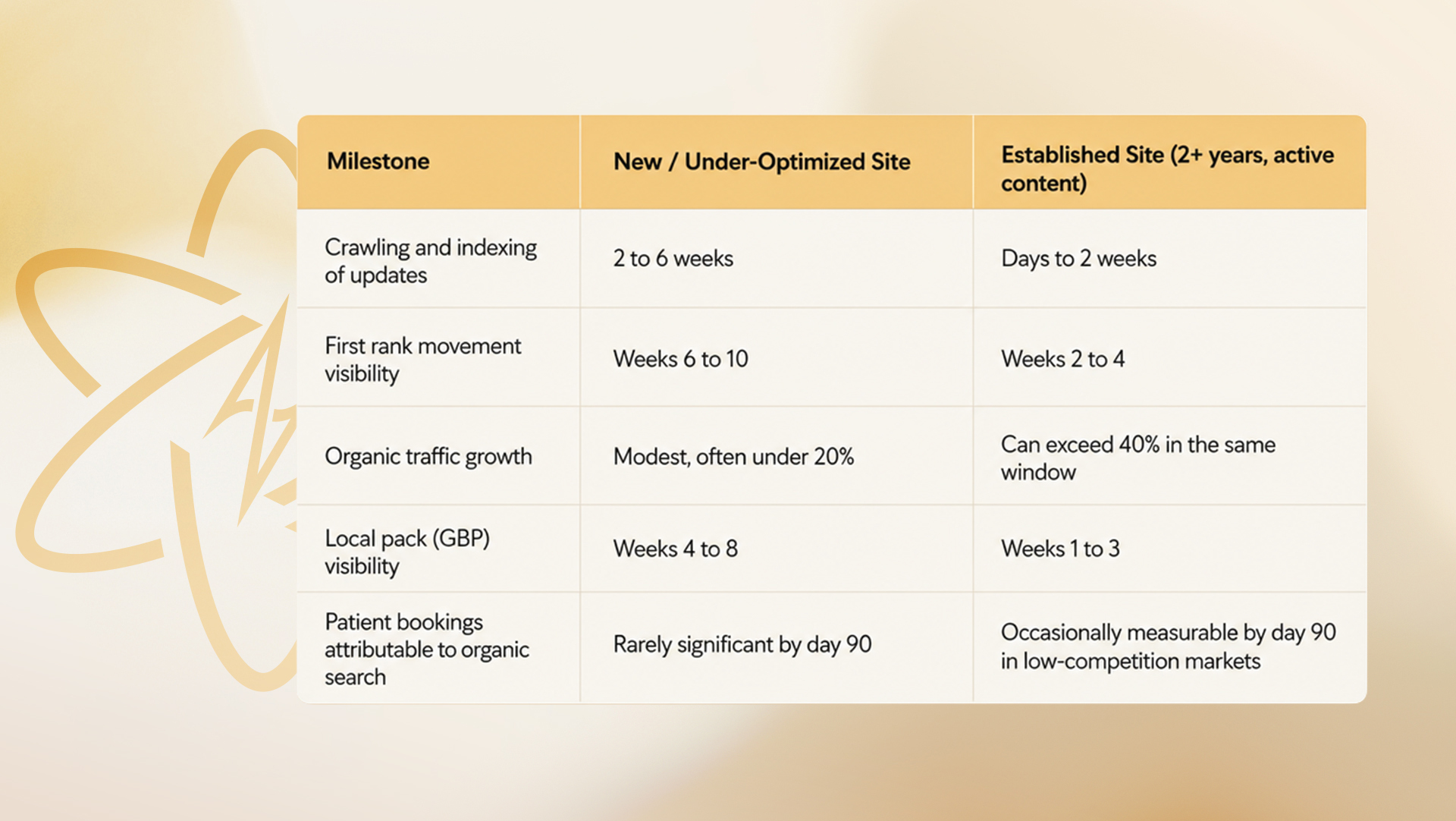
90-Day SEO Timeline: New Site vs. Established Site
The Bottom Line
Ninety days is enough time to know whether an SEO strategy is working. It's rarely enough time to see the patient volume that strategy will eventually produce.
The practices that get frustrated and pull back at day 90 are usually walking away right before the compounding effect of that work would have started showing up in bookings.
If you want a clear read on where your practice's SEO actually stands right now and a realistic timeline for your specific market, book a free SEO assessment and we'll walk you through exactly what to expect.
Frequently Asked Questions
Most med spas should expect early visibility gains in 90 days, not a flood of new patients. SEO on a new or under-optimized site typically starts converting into real booked appointments somewhere between month four and month six, once Google has had time to trust the changes.
That timeline frustrates owners who were sold on faster numbers. It's the same expectations gap we cover in why aestheticians lose clients online, just showing up as a timeline problem instead of a visibility problem.
Key Takeaways
- 90 days is enough time to see ranking movement and traffic growth, but rarely enough time to see a large volume of new booked patients.
- The realistic patient-volume timeline runs 4 to 6 months for most local service pages, longer in competitive metro markets.
- A site with zero prior SEO work sees a different 90-day curve than a site with an existing content and backlink base.
- Tracking rankings and organic traffic in the first 90 days is a better health check than tracking patient count alone.
- Local pack visibility (Google Business Profile placement) often moves faster than organic blog rankings and can produce earlier patient volume.
What Actually Happens to a Med Spa's SEO in the First 90 Days?
The first 90 days are mostly about Google re-evaluating the site, not patients finding it. New or updated pages need to be crawled, indexed, and then tested against competing pages before rankings settle.
That process alone can take 4 to 8 weeks before any movement shows up in rank tracking.
Once movement starts, it's usually gradual: a page moves from position 40 to position 18, then from 18 to 9, over successive weeks. That's real progress, but position 9 for a competitive term like "Botox near me" still isn't generating meaningful call or booking volume.
The patient volume tends to show up once a page holds a top-5 position consistently, which is rarely a 90-day outcome for a competitive keyword in a mid-size or large metro market.
Why Do SEO Agencies Sometimes Promise Faster Results Than This?
Some agencies quote early wins because early wins are real, they're just not the same thing as new patients. Traffic increases, keyword rankings climbing, and improved Google Business Profile visibility can all happen inside 90 days and are worth reporting honestly.
The problem is when those metrics get framed as patient-volume promises rather than what they actually are: leading indicators.
A practice seeing a 40% increase in organic sessions in month three should treat that as a sign the strategy is working, not as a stand-in for booked appointments.
The American Med Spa Association has noted the same gap in owner expectations across the med spa industry broadly: marketing metrics and revenue metrics move on different clocks, and conflating them sets owners up to judge a working strategy as a failing one.
Does a Brand-New Website Move Slower Than an Established One?
Yes, and the gap is significant. A domain with no prior content, no backlinks, and no established trust with Google is starting from zero, sometimes called the "sandbox" effect informally in SEO circles, where new sites see suppressed rankings for the first several months regardless of content quality.
An existing site with a few years of published content and some earned backlinks can see 90-day movement that a brand-new site simply can't match, because Google already has a trust baseline to build on.
This is one of the biggest variables that gets left out of blanket 90-day promises: the starting point matters as much as the work done during the 90 days.
It's a similar foundation problem to the one covered in our med spa marketing guide for 2026: strategy quality matters, but so does what a practice is starting from.
What Should a Med Spa Actually Measure at the 90-Day Mark?
Keyword rank position for target procedure and location terms, organic session growth compared to the prior quarter, and Google Business Profile impressions and calls are the three metrics that reliably move in 90 days and reflect real progress.
Booked-appointment attribution to organic search is the metric that lags behind all three.
A practice can reasonably expect double-digit percentage growth in organic sessions by month three if the technical foundation was sound going in.
Direct patient bookings attributable to that traffic growth typically follow a quarter or two later, once rankings stabilize in positions patients actually click.
How Does Market Competition Change the Timeline?
A med spa in a smaller metro with fewer competing practices can see patient-generating rankings faster than one in a saturated market like Los Angeles or Miami, where dozens of practices are competing for the same procedure and location keywords.
Competitive density is one of the single biggest factors in how fast 90 days turns into visible patient volume, more than most owners initially expect.
90-Day SEO Timeline: New Site vs. Established Site
The Bottom Line
Ninety days is enough time to know whether an SEO strategy is working. It's rarely enough time to see the patient volume that strategy will eventually produce.
The practices that get frustrated and pull back at day 90 are usually walking away right before the compounding effect of that work would have started showing up in bookings.
If you want a clear read on where your practice's SEO actually stands right now and a realistic timeline for your specific market, book a free SEO assessment and we'll walk you through exactly what to expect.
Frequently Asked Questions

At Aestheticians Digital, big ideas deserve bold execution.
Table of Content
Get insghts that drive results.
Contact us for strategy, design tips, and industry insights—straight to your inbox.
.svg)
.svg)
MEET THE AUTORS


© Copyright 2026 | Design & Developed By Aesthetics Digital LLC.