
How Can a Med Spa Tell Whether Google Maps or Website SEO Produced a Booking?
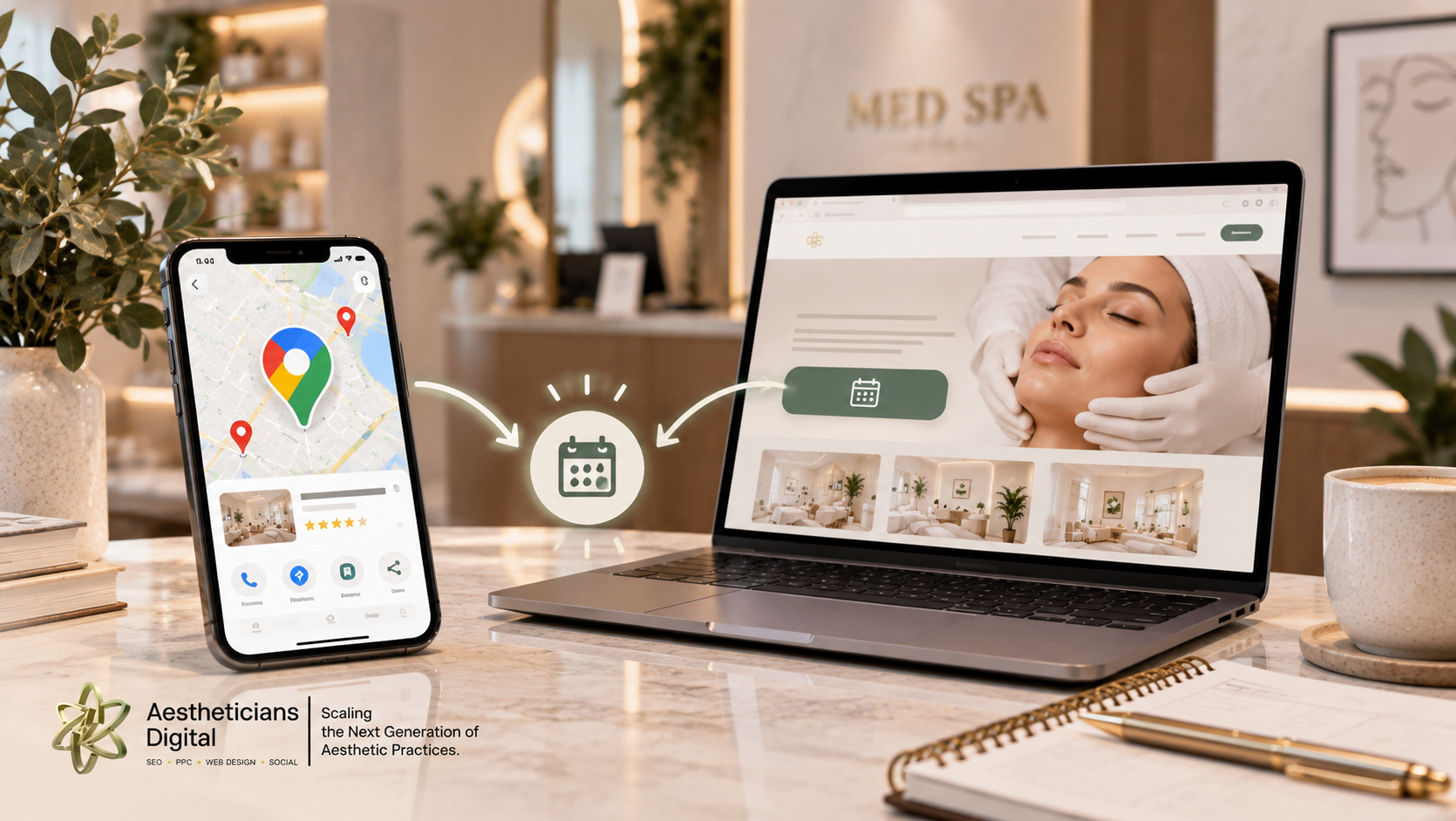
A med spa can tell whether Google Maps or website SEO produced a booking by tracking three separate stages: where the patient discovered the practice, where the patient became a lead, and whether that lead became a booked appointment.
The reason matters. Google Business Profile, GA4, call tracking, and your CRM measure different parts of the journey. Looking at only one creates an interaction-to-booking gap.
Key Takeaways
- A Google Maps interaction is not automatically a booking.
- Tagging your Google Business Profile website link helps separate Maps traffic from standard organic search traffic.
- Forms, calls, and online booking actions need source tracking.
- First touch and last touch can credit different channels for the same patient.
- The useful business metric is not clicks. It is booked appointments by acquisition source.
Can Google Business Profile Tell a Med Spa Which Patients Actually Booked?
Google Business Profile can show how people interact with your listing, but it cannot independently reconstruct the full patient journey.
Google's Business Profile performance documentation says profile owners can measure website clicks, directions, calls, and other interactions. Google defines calls as clicks on the profile's call button. It reports completed bookings when bookings are managed through a supported booking provider.
That creates an important distinction:
Interaction ≠ lead ≠ booked patient.
Think about attribution in three layers:
- Discovery: Where did the patient first find you?
- Lead: What interaction produced the inquiry?
- Booking: Did that inquiry become a scheduled consultation or treatment?
A patient could discover your med spa in Maps, read reviews, visit your website, leave, search your name two days later, and then book.
If reporting gives all the credit to the final organic visit, Maps disappears from the journey even though it created the discovery.
This is the central attribution problem.
For practices investing in med spa SEO and patient acquisition, both channels should therefore be measured as parts of one conversion system.
.png)
How Do You Separate Google Maps Traffic From Website SEO Traffic?
Tag the website URL used in your Google Business Profile so visits from the profile can be identified separately from ordinary organic search visits.
A practical campaign structure can distinguish:
- Google Business Profile website visits
- Standard Google organic visits
- Direct traffic
- Paid search
- Social and referral traffic
Without that separation, a person who clicks your GBP website button may simply appear inside a broader reporting bucket after reaching the site.
That makes the comparison unreliable.
Your existing Google Business Profile vs. website SEO guide explains what each search surface contributes. Attribution is the next step: which surface actually initiated or assisted a booked-patient journey?
How Should a Med Spa Set Up Booking Attribution Step by Step?
A workable med spa attribution system should connect the acquisition source to the lead and then preserve that source until the appointment outcome is known.
Use this seven-step setup:
- Tag the GBP website link. Give visits from your Business Profile a distinct campaign source.
- Separate GBP and organic search sessions. Do not report them as one generic SEO bucket.
- Track consultation forms. Capture the original source when the form is submitted.
- Track online-booking actions. Connect completed booking events where your scheduling system allows it.
- Use source-aware call tracking. Identify whether calls originate from GBP or website visitors where technically appropriate.
- Preserve original source in the CRM. Do not overwrite discovery data when the patient returns through another channel.
- Record the appointment outcome. Mark leads as booked, unbooked, canceled, or otherwise relevant to your reporting process.
This produces the metric owners actually need:
Source → Leads → Confirmed bookings
Aestheticians Digital describes its own patient acquisition framework as connecting SEO, websites, CRM infrastructure, conversion systems, and follow-up rather than treating traffic as the final outcome.
Which Attribution Model Should a Med Spa Use?
Use first-touch, last-touch, and booked-patient data together because each answers a different question.
Consider this journey:
Google Maps → Website → Branded Google Search → Treatment Page → Booking
.png)
The mistake is asking which single channel “won.”
A better question is:
Which channel initiated the journey, which channel converted it, and did the patient actually book?
That is the difference between marketing attribution and traffic reporting.
.png)
Why Is “How Did You Hear About Us?” Not Enough?
Patient-reported attribution is useful, but it should support digital tracking rather than replace it.
A patient may answer “Google” even when the actual path was:
Maps → reviews → Instagram → website → Google search → booking
The patient is not necessarily wrong. “Google” is simply too broad to explain the journey.
A better intake question is:
“Where did you first hear about us?”
Then compare that answer with the original tracked source.
This is particularly important because content and social channels can assist the same decision. For example, the relationship between search and social is explored further in why med spas still need blogs when they are active on Instagram.
How Can You Tell Whether Your Attribution System Is Broken?
Your attribution system is probably incomplete if marketing reports traffic, leads, and appointments in separate systems that cannot be reconciled.
Watch for these warning signs:
- GBP reports 70 calls, but nobody knows how many booked.
- GA4 reports organic conversions, but those conversions are not matched to CRM records.
- Your CRM says “Google” without distinguishing Maps from organic search.
- Booking software records appointments but loses the original acquisition source.
- Your agency reports rankings and clicks without showing bookings by source.
- Repeat visits overwrite the patient's first-touch source.
A reporting dashboard with more charts does not solve these gaps.
The shared identifier between source, lead, and appointment is what creates useful attribution.
Aestheticians Digital's aesthetic-practice case studies also emphasize conversion optimization, booking flows, tracking, CRM systems, and patient journeys rather than traffic alone.
.png)
Does Med Spa Booking Attribution Create HIPAA or Privacy Concerns?
It can, depending on the practice, data collected, and tracking configuration. Avoid sending patient or treatment information into marketing platforms merely to improve attribution.
HHS states that HIPAA-regulated entities must consider their obligations when tracking technologies collect or disclose protected health information. Its current online tracking technology guidance also notes that part of earlier guidance concerning some unauthenticated public webpages was vacated by a federal court in June 2024.
The issue is especially relevant to medical spas. Patrick O'Brien, JD, and Derek Hauk of the American Med Spa Association discussed pixel-tracking lawsuits involving healthcare and med spa websites in AmSpa's September 14, 2026 tracking-technology guidance for medical spas.
Privacy architecture should therefore be reviewed by qualified legal or compliance professionals where applicable.
What Should a Med Spa Ask Its Marketing Agency to Report?
Ask for booked-patient attribution, not a report dominated by rankings, impressions, and clicks.
Your monthly report should answer:
- How many leads originated from GBP?
- How many originated from organic website search?
- How many became confirmed appointments?
- Which journeys involved both channels?
- Which sources cannot currently be attributed?
- Where are leads being lost between inquiry and booking?
If your marketing team cannot answer those questions, you do not yet have complete booking attribution.
That is the commercial difference.
Traffic tells you whether people arrived. Attribution tells you what produced patients.
Stop Measuring the Click. Measure the Patient Journey.
The question is not simply whether Google Maps or website SEO produced the click. The useful question is where the patient discovered you, where the inquiry occurred, and whether that inquiry became an appointment.
Sometimes Maps starts the journey and website SEO closes it. Sometimes organic search starts it. Often, both contribute.
Aestheticians Digital focuses on real bookings rather than disconnected traffic metrics. You can review the team's approach to aesthetic practice growth or request an attribution and patient-acquisition assessment if your current reporting cannot connect search visibility to booked consultations.
FAQs
A med spa can tell whether Google Maps or website SEO produced a booking by tracking three separate stages: where the patient discovered the practice, where the patient became a lead, and whether that lead became a booked appointment.
The reason matters. Google Business Profile, GA4, call tracking, and your CRM measure different parts of the journey. Looking at only one creates an interaction-to-booking gap.
Key Takeaways
- A Google Maps interaction is not automatically a booking.
- Tagging your Google Business Profile website link helps separate Maps traffic from standard organic search traffic.
- Forms, calls, and online booking actions need source tracking.
- First touch and last touch can credit different channels for the same patient.
- The useful business metric is not clicks. It is booked appointments by acquisition source.
Can Google Business Profile Tell a Med Spa Which Patients Actually Booked?
Google Business Profile can show how people interact with your listing, but it cannot independently reconstruct the full patient journey.
Google's Business Profile performance documentation says profile owners can measure website clicks, directions, calls, and other interactions. Google defines calls as clicks on the profile's call button. It reports completed bookings when bookings are managed through a supported booking provider.
That creates an important distinction:
Interaction ≠ lead ≠ booked patient.
Think about attribution in three layers:
- Discovery: Where did the patient first find you?
- Lead: What interaction produced the inquiry?
- Booking: Did that inquiry become a scheduled consultation or treatment?
A patient could discover your med spa in Maps, read reviews, visit your website, leave, search your name two days later, and then book.
If reporting gives all the credit to the final organic visit, Maps disappears from the journey even though it created the discovery.
This is the central attribution problem.
For practices investing in med spa SEO and patient acquisition, both channels should therefore be measured as parts of one conversion system.
How Do You Separate Google Maps Traffic From Website SEO Traffic?
Tag the website URL used in your Google Business Profile so visits from the profile can be identified separately from ordinary organic search visits.
A practical campaign structure can distinguish:
- Google Business Profile website visits
- Standard Google organic visits
- Direct traffic
- Paid search
- Social and referral traffic
Without that separation, a person who clicks your GBP website button may simply appear inside a broader reporting bucket after reaching the site.
That makes the comparison unreliable.
Your existing Google Business Profile vs. website SEO guide explains what each search surface contributes. Attribution is the next step: which surface actually initiated or assisted a booked-patient journey?
How Should a Med Spa Set Up Booking Attribution Step by Step?
A workable med spa attribution system should connect the acquisition source to the lead and then preserve that source until the appointment outcome is known.
Use this seven-step setup:
- Tag the GBP website link. Give visits from your Business Profile a distinct campaign source.
- Separate GBP and organic search sessions. Do not report them as one generic SEO bucket.
- Track consultation forms. Capture the original source when the form is submitted.
- Track online-booking actions. Connect completed booking events where your scheduling system allows it.
- Use source-aware call tracking. Identify whether calls originate from GBP or website visitors where technically appropriate.
- Preserve original source in the CRM. Do not overwrite discovery data when the patient returns through another channel.
- Record the appointment outcome. Mark leads as booked, unbooked, canceled, or otherwise relevant to your reporting process.
This produces the metric owners actually need:
Source → Leads → Confirmed bookings
Aestheticians Digital describes its own patient acquisition framework as connecting SEO, websites, CRM infrastructure, conversion systems, and follow-up rather than treating traffic as the final outcome.
Which Attribution Model Should a Med Spa Use?
Use first-touch, last-touch, and booked-patient data together because each answers a different question.
Consider this journey:
Google Maps → Website → Branded Google Search → Treatment Page → Booking
The mistake is asking which single channel “won.”
A better question is:
Which channel initiated the journey, which channel converted it, and did the patient actually book?
That is the difference between marketing attribution and traffic reporting.
Why Is “How Did You Hear About Us?” Not Enough?
Patient-reported attribution is useful, but it should support digital tracking rather than replace it.
A patient may answer “Google” even when the actual path was:
Maps → reviews → Instagram → website → Google search → booking
The patient is not necessarily wrong. “Google” is simply too broad to explain the journey.
A better intake question is:
“Where did you first hear about us?”
Then compare that answer with the original tracked source.
This is particularly important because content and social channels can assist the same decision. For example, the relationship between search and social is explored further in why med spas still need blogs when they are active on Instagram.
How Can You Tell Whether Your Attribution System Is Broken?
Your attribution system is probably incomplete if marketing reports traffic, leads, and appointments in separate systems that cannot be reconciled.
Watch for these warning signs:
- GBP reports 70 calls, but nobody knows how many booked.
- GA4 reports organic conversions, but those conversions are not matched to CRM records.
- Your CRM says “Google” without distinguishing Maps from organic search.
- Booking software records appointments but loses the original acquisition source.
- Your agency reports rankings and clicks without showing bookings by source.
- Repeat visits overwrite the patient's first-touch source.
A reporting dashboard with more charts does not solve these gaps.
The shared identifier between source, lead, and appointment is what creates useful attribution.
Aestheticians Digital's aesthetic-practice case studies also emphasize conversion optimization, booking flows, tracking, CRM systems, and patient journeys rather than traffic alone.
Does Med Spa Booking Attribution Create HIPAA or Privacy Concerns?
It can, depending on the practice, data collected, and tracking configuration. Avoid sending patient or treatment information into marketing platforms merely to improve attribution.
HHS states that HIPAA-regulated entities must consider their obligations when tracking technologies collect or disclose protected health information. Its current online tracking technology guidance also notes that part of earlier guidance concerning some unauthenticated public webpages was vacated by a federal court in June 2024.
The issue is especially relevant to medical spas. Patrick O'Brien, JD, and Derek Hauk of the American Med Spa Association discussed pixel-tracking lawsuits involving healthcare and med spa websites in AmSpa's September 14, 2026 tracking-technology guidance for medical spas.
Privacy architecture should therefore be reviewed by qualified legal or compliance professionals where applicable.
What Should a Med Spa Ask Its Marketing Agency to Report?
Ask for booked-patient attribution, not a report dominated by rankings, impressions, and clicks.
Your monthly report should answer:
- How many leads originated from GBP?
- How many originated from organic website search?
- How many became confirmed appointments?
- Which journeys involved both channels?
- Which sources cannot currently be attributed?
- Where are leads being lost between inquiry and booking?
If your marketing team cannot answer those questions, you do not yet have complete booking attribution.
That is the commercial difference.
Traffic tells you whether people arrived. Attribution tells you what produced patients.
Stop Measuring the Click. Measure the Patient Journey.
The question is not simply whether Google Maps or website SEO produced the click. The useful question is where the patient discovered you, where the inquiry occurred, and whether that inquiry became an appointment.
Sometimes Maps starts the journey and website SEO closes it. Sometimes organic search starts it. Often, both contribute.
Aestheticians Digital focuses on real bookings rather than disconnected traffic metrics. You can review the team's approach to aesthetic practice growth or request an attribution and patient-acquisition assessment if your current reporting cannot connect search visibility to booked consultations.
FAQs

At Aestheticians Digital, big ideas deserve bold execution.
Table of Content
Get insghts that drive results.
Contact us for strategy, design tips, and industry insights—straight to your inbox.
.svg)
.svg)
MEET THE AUTORS


© Copyright 2026 | Design & Developed By Aesthetics Digital LLC.