
Why Your Med Spa's Google Reviews Aren't Enough Anymore (What AI Actually Reads)
.jpg)
A five-star Google rating no longer decides whether AI recommends your med spa. Review structure does. When ChatGPT, Perplexity, and Google's AI Overviews decide which practice to surface for “best Botox provider near me,” they're not counting stars.
They're parsing text for specifics: clinician names, treatment names, timelines, and outcomes.
Star ratings still matter for human trust. But the machines reading your reviews before a human ever clicks through are looking for something else entirely, and most med spas haven't caught up.
It's the same visibility gap we broke down in why aestheticians lose clients online, just showing up in a different part of the funnel.
Key Takeaways
- AI answer engines extract specifics from review text (clinician name, treatment, timeframe, result), not aggregate star ratings.
- A 4.9-star page with vague reviews ("great service!") can lose visibility to a 4.6-star competitor with specific and detailed reviews.
- Review velocity and recency now function as freshness signals for AI retrieval, not just SEO ranking factors.
- Structured review requests that prompt for specifics outperform generic "leave us a review" asks.
- Entity consistency (how your practice name and provider names appear across platforms) directly affects whether AI systems trust and cite your reviews at all.
Why Aren't Star Ratings Enough for AI Visibility Anymore?
Star ratings are a compressed number. AI retrieval models don't work in compressed numbers, they work in extractable text.
When a large language model answers "which med spa in [city] is good for lip filler," it's decomposing that question into fragments: lip filler results, lip filler pain level, lip filler provider reputation.
A 4.8-star aggregate score answers none of those fragments directly.
A review that says "Dr. Reyes gave me natural-looking lip filler results, healed in about 5 days, barely any bruising" answers three fragments in one sentence.
That review gets pulled into an AI-generated answer. The star rating sitting next to it doesn't get quoted at all, because there's nothing in a number for a model to paraphrase.
What Makes a Review Actually Readable to AI Answer Engines?
A review becomes machine-extractable when it names a specific clinician, a specific treatment, and a specific outcome or timeframe, all in the same sentence or two.
Generic praise "amazing staff, highly recommend" contains zero fragments a model can retrieve, so it functions as social proof for a human skimmer but as dead weight for AI citation.
The strongest reviews in this vertical read almost like mini case studies. "Injector Sarah adjusted my Botox dose after my first appointment left me slightly asymmetrical, and the follow-up was flawless."
This review does three jobs: names a person, names a problem, and names a resolution. Practices offering med spa services see this pattern most in injectable reviews specifically, since outcomes there are easiest to describe in concrete, checkable terms.
Does Review Recency Actually Affect AI Citation?
Yes, and the effect appears sharper for AI retrieval than it ever was for classic SEO. Reviews older than a few months carry less retrieval weight in fast-moving categories, because AI systems weight freshness as a proxy for whether a practice's current pricing, staff, and services still match what's being described.
A practice with 200 reviews from three years ago and none since reads as stale to a retrieval model, even if the star average is excellent.
A practice with 15 reviews from the past 60 days reads as active and current. Consistent review velocity, meaning a steady trickle rather than one bulk request every six months, keeps the profile inside whatever recency window the model is weighting.
How Should a Med Spa Actually Ask for Reviews Now?
Ask for SPECIFICS, not just a rating. A generic "please leave us a review" prompt produces generic text that AI systems can't extract anything from. A structured ask, something like "tell us which treatment you had and what results you noticed," produces review text that already contains the fragments a model needs.
Some practices build this into the actual review request flow: a short post-visit form that asks which treatment someone had, who their provider was, and what result stood out, before the reviewer even gets to the star selector.
The FDA's guidance on cosmetic injectable safety is a useful reference point here too: patients researching a treatment are often looking for exactly the kind of outcome and recovery detail a structured review naturally surfaces.
Why Does Entity Consistency Matter for Review Visibility?
Because AI systems reason about your practice as an entity, not a keyword. If your practice is listed as "Bloom Aesthetics" on Google, "Bloom Aesthetics Med Spa" on Yelp, and "Bloom Aesthetic Clinic" in your own reviews, a retrieval model can't confidently merge those signals into one trusted source.
It's the identical entity-confusion problem outlined in why dentists lose patients online, just applied to reviews instead of website copy.
The same applies to provider names. If a reviewer writes "Dr. Reyes" but your website lists "Dr. Michael Reyes, MD," the model has to work harder to connect them, and inconsistency compounds across enough reviews to measurably dilute trust signals.
Locking down one consistent name format across your Google Business Profile, website, and every directory removes that friction entirely.
Star Ratings vs. Review Text: What Each One Actually Does
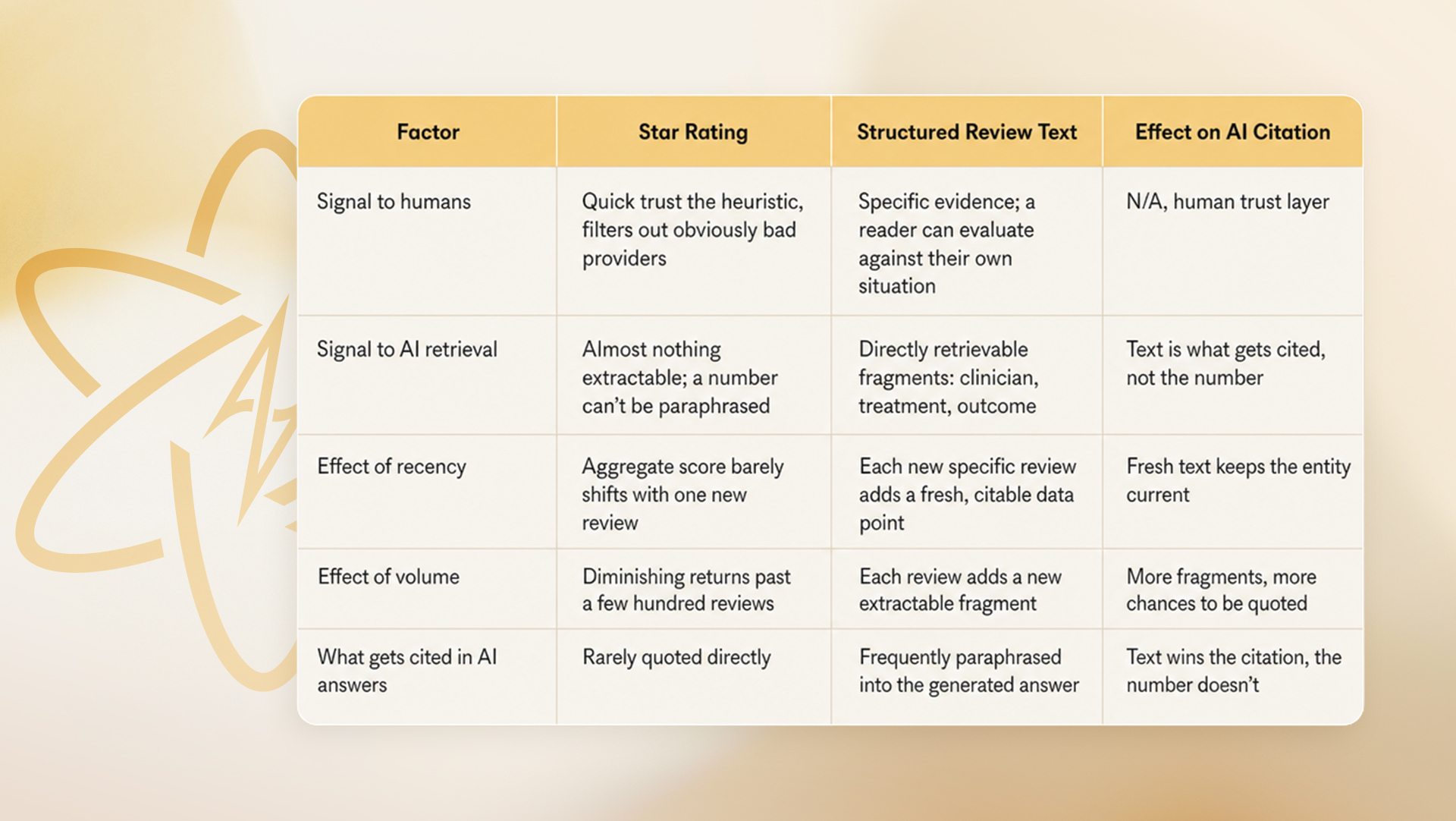
The Bottom Line
Star ratings will keep earning the click. Review text is what earns the citation. A med spa that keeps collecting generic five-star praise while a competitor collects detailed, specific reviews is losing ground in AI-generated answers that most patients now see before they ever load a website.
Fixing this doesn't require new software or a bigger review volume goal. It requires asking for the right kind of detail and keeping your practice's name consistent everywhere it appears.
If you want a full breakdown of how your current review profile reads to AI systems, book an AI visibility audit and we'll show you exactly what's missing.
Frequently Asked Questions
A five-star Google rating no longer decides whether AI recommends your med spa. Review structure does. When ChatGPT, Perplexity, and Google's AI Overviews decide which practice to surface for “best Botox provider near me,” they're not counting stars.
They're parsing text for specifics: clinician names, treatment names, timelines, and outcomes.
Star ratings still matter for human trust. But the machines reading your reviews before a human ever clicks through are looking for something else entirely, and most med spas haven't caught up.
It's the same visibility gap we broke down in why aestheticians lose clients online, just showing up in a different part of the funnel.
Key Takeaways
- AI answer engines extract specifics from review text (clinician name, treatment, timeframe, result), not aggregate star ratings.
- A 4.9-star page with vague reviews ("great service!") can lose visibility to a 4.6-star competitor with specific and detailed reviews.
- Review velocity and recency now function as freshness signals for AI retrieval, not just SEO ranking factors.
- Structured review requests that prompt for specifics outperform generic "leave us a review" asks.
- Entity consistency (how your practice name and provider names appear across platforms) directly affects whether AI systems trust and cite your reviews at all.
Why Aren't Star Ratings Enough for AI Visibility Anymore?
Star ratings are a compressed number. AI retrieval models don't work in compressed numbers, they work in extractable text.
When a large language model answers "which med spa in [city] is good for lip filler," it's decomposing that question into fragments: lip filler results, lip filler pain level, lip filler provider reputation.
A 4.8-star aggregate score answers none of those fragments directly.
A review that says "Dr. Reyes gave me natural-looking lip filler results, healed in about 5 days, barely any bruising" answers three fragments in one sentence.
That review gets pulled into an AI-generated answer. The star rating sitting next to it doesn't get quoted at all, because there's nothing in a number for a model to paraphrase.
What Makes a Review Actually Readable to AI Answer Engines?
A review becomes machine-extractable when it names a specific clinician, a specific treatment, and a specific outcome or timeframe, all in the same sentence or two.
Generic praise "amazing staff, highly recommend" contains zero fragments a model can retrieve, so it functions as social proof for a human skimmer but as dead weight for AI citation.
The strongest reviews in this vertical read almost like mini case studies. "Injector Sarah adjusted my Botox dose after my first appointment left me slightly asymmetrical, and the follow-up was flawless."
This review does three jobs: names a person, names a problem, and names a resolution. Practices offering med spa services see this pattern most in injectable reviews specifically, since outcomes there are easiest to describe in concrete, checkable terms.
Does Review Recency Actually Affect AI Citation?
Yes, and the effect appears sharper for AI retrieval than it ever was for classic SEO. Reviews older than a few months carry less retrieval weight in fast-moving categories, because AI systems weight freshness as a proxy for whether a practice's current pricing, staff, and services still match what's being described.
A practice with 200 reviews from three years ago and none since reads as stale to a retrieval model, even if the star average is excellent.
A practice with 15 reviews from the past 60 days reads as active and current. Consistent review velocity, meaning a steady trickle rather than one bulk request every six months, keeps the profile inside whatever recency window the model is weighting.
How Should a Med Spa Actually Ask for Reviews Now?
Ask for SPECIFICS, not just a rating. A generic "please leave us a review" prompt produces generic text that AI systems can't extract anything from. A structured ask, something like "tell us which treatment you had and what results you noticed," produces review text that already contains the fragments a model needs.
Some practices build this into the actual review request flow: a short post-visit form that asks which treatment someone had, who their provider was, and what result stood out, before the reviewer even gets to the star selector.
The FDA's guidance on cosmetic injectable safety is a useful reference point here too: patients researching a treatment are often looking for exactly the kind of outcome and recovery detail a structured review naturally surfaces.
Why Does Entity Consistency Matter for Review Visibility?
Because AI systems reason about your practice as an entity, not a keyword. If your practice is listed as "Bloom Aesthetics" on Google, "Bloom Aesthetics Med Spa" on Yelp, and "Bloom Aesthetic Clinic" in your own reviews, a retrieval model can't confidently merge those signals into one trusted source.
It's the identical entity-confusion problem outlined in why dentists lose patients online, just applied to reviews instead of website copy.
The same applies to provider names. If a reviewer writes "Dr. Reyes" but your website lists "Dr. Michael Reyes, MD," the model has to work harder to connect them, and inconsistency compounds across enough reviews to measurably dilute trust signals.
Locking down one consistent name format across your Google Business Profile, website, and every directory removes that friction entirely.
Star Ratings vs. Review Text: What Each One Actually Does
The Bottom Line
Star ratings will keep earning the click. Review text is what earns the citation. A med spa that keeps collecting generic five-star praise while a competitor collects detailed, specific reviews is losing ground in AI-generated answers that most patients now see before they ever load a website.
Fixing this doesn't require new software or a bigger review volume goal. It requires asking for the right kind of detail and keeping your practice's name consistent everywhere it appears.
If you want a full breakdown of how your current review profile reads to AI systems, book an AI visibility audit and we'll show you exactly what's missing.
Frequently Asked Questions

At Aestheticians Digital, big ideas deserve bold execution.
Table of Content
Get insghts that drive results.
Contact us for strategy, design tips, and industry insights—straight to your inbox.
.svg)
.svg)
MEET THE AUTORS


© Copyright 2026 | Design & Developed By Aesthetics Digital LLC.