
Why Do Patients Click “Book Now” but Leave Before Scheduling? A Med Spa Website Checklist
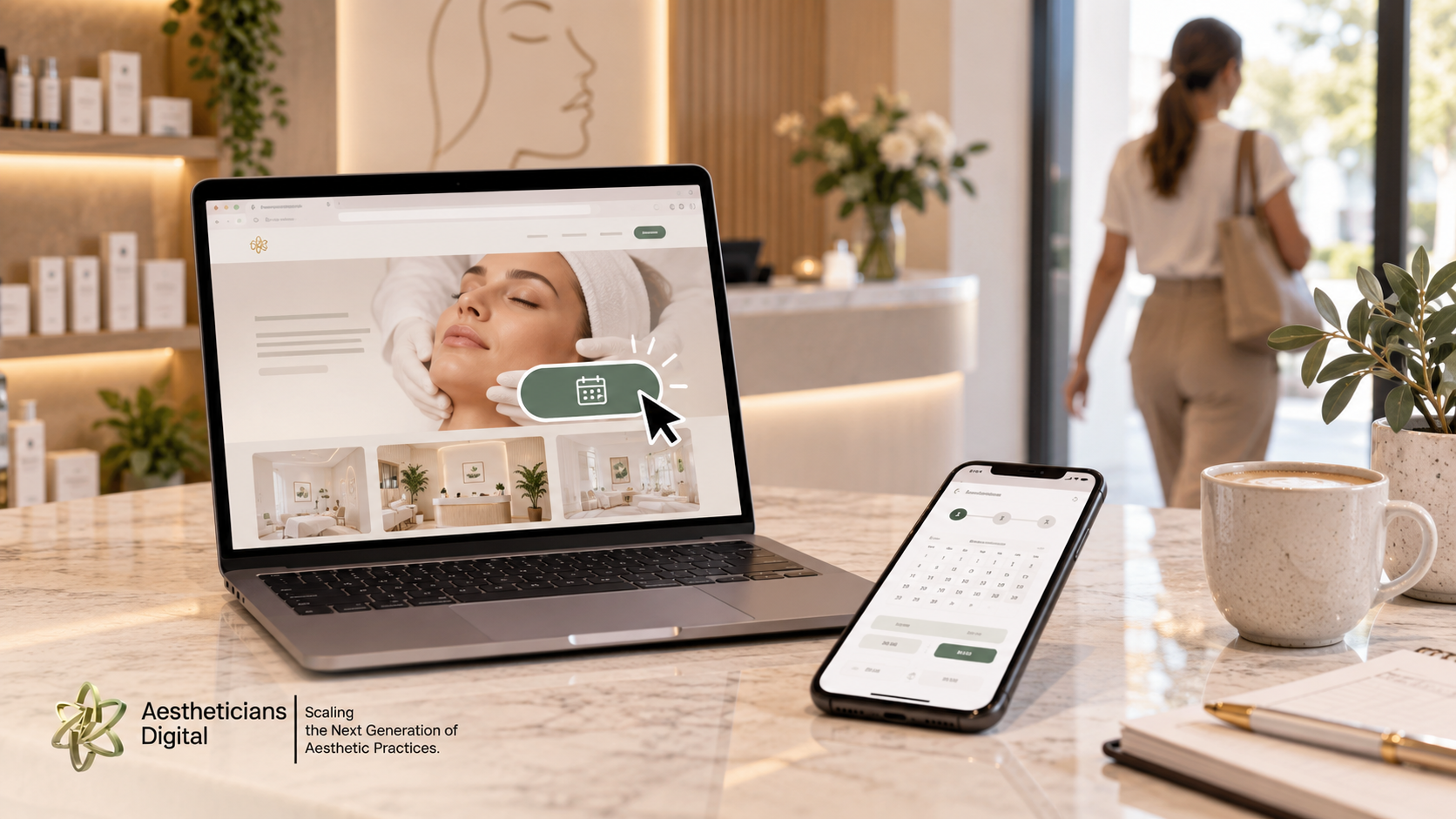
Patients often click “Book Now” but leave before scheduling because the booking experience introduces new friction after they have already decided to act. The problem may be a slow scheduler, confusing treatment choices, an unexpected third-party page, account creation, too many fields, weak mobile UX, or uncertainty about what happens next.
That distinction matters. If patients are already clicking the CTA, your problem is no longer CTA visibility. It is the booking completion.
We call this the post-click booking gap.
Key Takeaways
- A Book Now click proves intent, not a completed appointment.
- Med spas should track booking starts and booking completions separately.
- Third-party schedulers can create friction when the branding, navigation, or experience suddenly changes.
- Mobile speed, treatment selection, provider choice, required fields, and trust all matter after the click.
- The best website audit follows the patient from Book Now → scheduler → treatment selection → time selection → confirmation.
-
Why Would a Patient Click “Book Now” and Then Leave?
A patient who clicks Book Now has already crossed an important conversion threshold, so abandonment after that point usually means the booking process created friction or uncertainty.
That is different from a visitor who never clicks.
Many med spa conversion guides focus on stronger calls to action, clearer treatment pages, trust signals, and more visible booking buttons. Those improvements matter, but they do not diagnose what happens after a high-intent visitor has already chosen to schedule.
The American Med Spa Association recommends simplifying booking, minimizing unnecessary steps, supporting mobile scheduling, and making availability easy to understand.
For a practice investing in med spa marketing and patient acquisition, that means the booking funnel itself must be audited as carefully as the homepage.
A useful framework is:
Book Now click → Scheduler opens → Treatment selected → Provider/time selected → Information submitted → Booking confirmed
Every drop between those stages is measurable.
.png)
Does the Booking Page Feel Like the Same Med Spa Website?
A sudden visual or technical handoff can make a patient hesitate, especially when Book Now opens a scheduler that looks unrelated to the website they just trusted.
Check what happens when you tap your own button.
Does the scheduler:
- open on another domain?
- use different colors and typography?
- remove your med spa's name or recognizable branding?
- introduce unfamiliar navigation?
- open slowly?
- make returning to the treatment page difficult?
A third-party booking platform is not automatically a problem. An unexplained transition is.
The patient was evaluating one business and suddenly appears somewhere else.
Keep the practice name visible. Preserve visual continuity where the platform allows it. Explain what will happen before the click if the scheduler must open externally.
This should also be reviewed alongside your broader Google Maps vs. website SEO booking journey, because acquiring a high-intent visitor has little value if the booking handoff loses them.
Is Your Med Spa Booking Process Too Long?
Every required decision creates another point where a patient can stop, so the booking flow should request only what is necessary to schedule the next step safely and correctly.
Audit the process as a first-time patient, not as someone who already understands your software.
Look for:
- forced account creation before availability is visible;
- long intake forms before the appointment is secured;
- unnecessary demographic fields;
- email verification in the middle of booking;
- repeated information requests;
- too many treatment categories;
- provider choices with no explanation;
- unavailable dates shown only after several previous steps.
There is an important distinction here.
Scheduling and clinical intake do not always need to happen at the same moment.
If a full medical history is not required to reserve the appointment, asking for it before the time slot is secured may create avoidable friction. Your clinical and legal requirements still control what information must be collected and when.
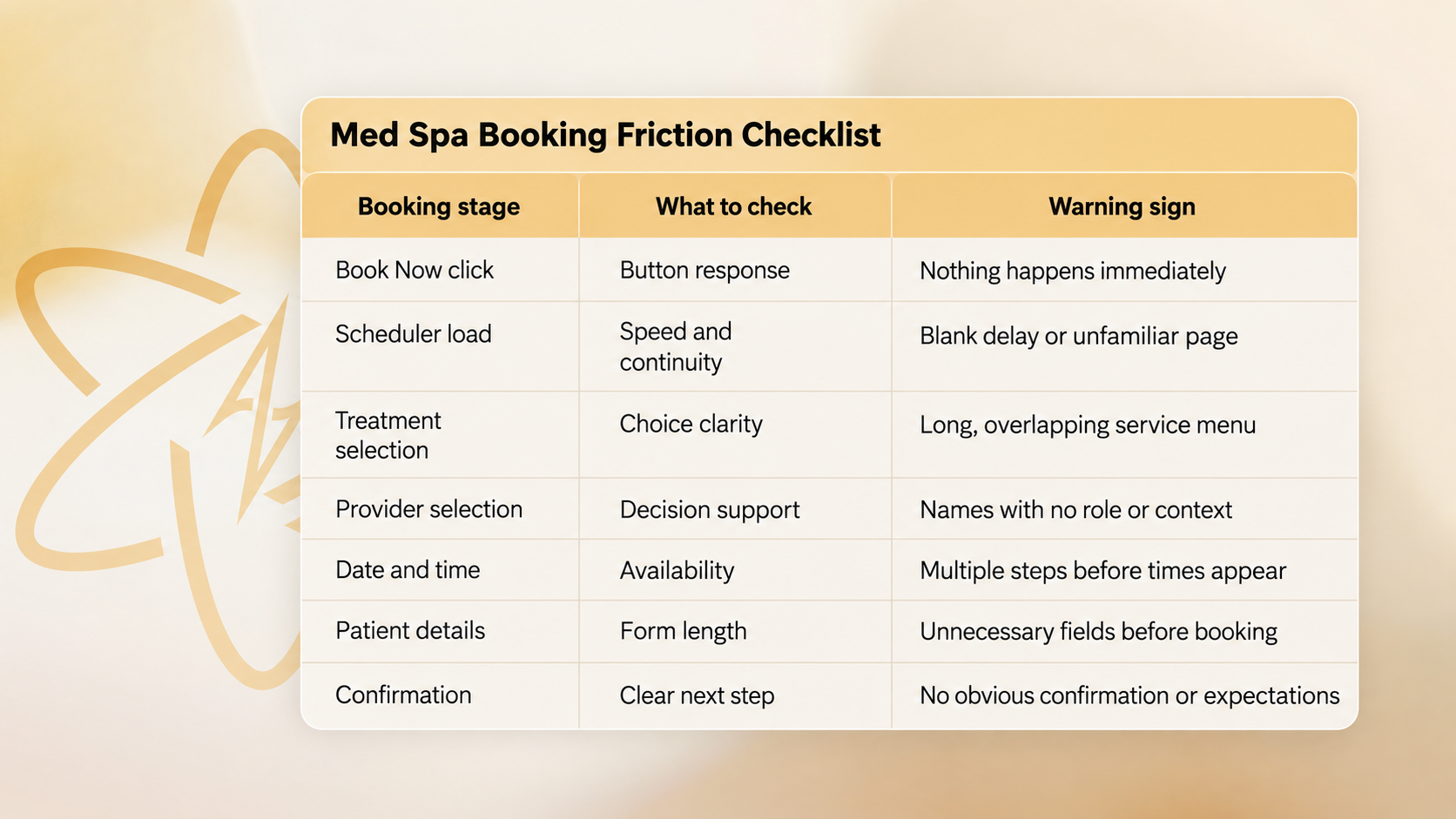
Med Spa Booking Friction Checklist
Are Patients Leaving Because They Do Not Know What to Book?
A patient can be ready to schedule but still abandon when the booking menu forces them to choose a treatment they do not understand.
This is common in aesthetics.
A prospective patient may know:
“I want something for forehead lines.”
They may not know whether your booking software expects them to choose:
- Botox,
- Dysport,
- neuromodulator consultation,
- injectable consultation,
- new-patient consultation,
- or a specific provider.
That is a website architecture problem disguised as a scheduling problem.
Give uncertain patients a clear path such as “Not sure which treatment? Book a consultation.”
Your treatment pages should also prepare patients before they reach the scheduler. They should understand what the service addresses, who may be an appropriate candidate, what the consultation involves, and what the next step is.
That relationship between education and conversion is one reason SEO content still matters even when a med spa is active on Instagram.
Is Mobile Friction Causing Booking Abandonment?
Mobile booking should be tested independently because a scheduler that works on desktop can still become difficult to use on a phone.
Google recommends evaluating page experience holistically, including Core Web Vitals, mobile display, security, and intrusive elements.
Test the complete booking journey on an actual phone.
Check whether:
- the Book Now button responds immediately;
- the scheduler fits within the viewport;
- dropdowns are easy to operate;
- calendars can be tapped accurately;
- the keyboard blocks important fields;
- popups cover the booking interface;
- form errors clearly explain what needs correcting;
- the page jumps while loading;
- confirmation is obvious after submission.
Google's Interaction to Next Paint metric specifically measures how quickly a page responds to taps, clicks, and keyboard interactions. Poor responsiveness can make an interface appear broken even when it eventually works.
.png)
Could Slow Loading or Technical Errors Be Losing Ready-to-Book Patients?
Yes. A Book Now button can technically work while the experience behind it performs poorly enough to lose users.
Do not test only whether the button reaches the correct URL.
Test:
- how long the scheduler takes to become usable;
- whether the first tap registers;
- whether scripts or widgets fail;
- whether available times load correctly;
- whether the form submits successfully;
- whether the confirmation event fires.
A technically functioning booking link can still be a conversion failure.
This is why Aestheticians Digital's broader approach to aesthetic-practice growth connects website performance, SEO, conversion systems, and patient acquisition rather than treating traffic as the end result.
Are You Measuring Book Now Clicks Instead of Completed Bookings?
Tracking only Book Now clicks hides the exact problem this checklist is meant to uncover.
Your analytics should distinguish at least:
- Book Now clicks;
- scheduler loads;
- booking starts;
- important booking steps where technically measurable;
- completed bookings;
- booking errors.
Example:
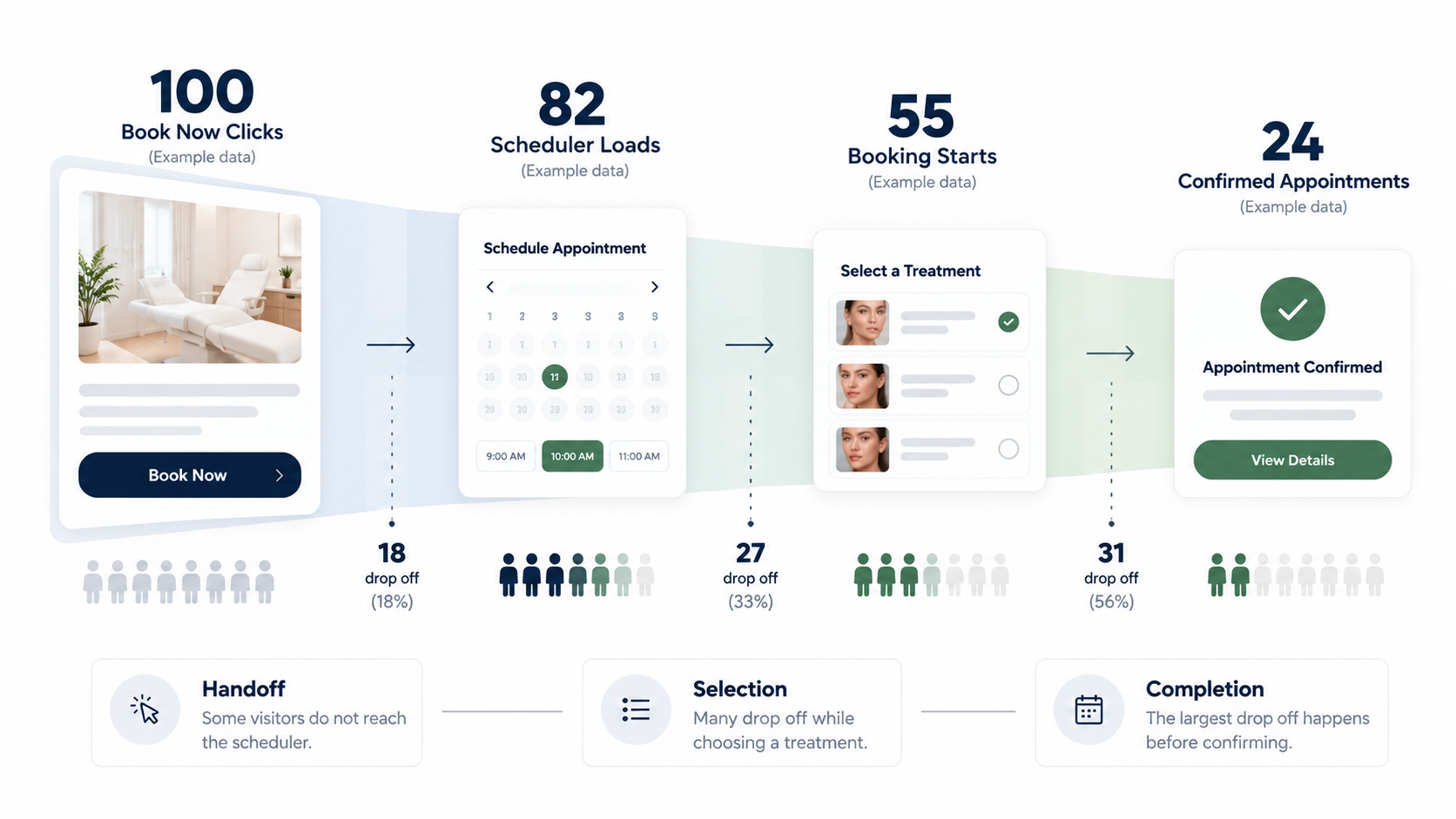
100 Book Now clicks → 82 scheduler loads → 55 booking starts → 24 confirmed appointments
Those are illustrative numbers, not an industry benchmark.
The point is diagnostic.
If 18% disappear before the scheduler loads, investigate the handoff or technical performance. If most abandonment happens during treatment selection, investigate choice architecture. If patients reach the final form but do not submit, investigate fields, errors, deposits, policies, or other final-step friction.
Does Booking Tracking Need a Privacy Review?
Potentially. Medical and healthcare practices should review what their booking pages and tracking technologies collect or disclose.
HHS states that HIPAA-regulated entities can have obligations when tracking technologies access or disclose protected health information. Appointment pages can be particularly relevant when information such as an email address or reason for seeking healthcare is collected. HHS also notes limits created by a June 2024 federal court ruling concerning parts of its earlier guidance on unauthenticated webpages.
Do not add tracking scripts to a medical booking flow simply because the marketing team wants more conversion data. Review the configuration with appropriate privacy, compliance, and legal professionals.
What Should a Med Spa Check Before Spending More on Traffic?
Fix post-click booking leakage before assuming the practice needs more visitors.
Run this checklist:
- Does Book Now work on mobile and desktop?
- Does the scheduler open quickly?
- Does the transition preserve trust?
- Can a new patient identify what to book?
- Can an unsure patient choose a consultation?
- Are unnecessary fields delaying the appointment?
- Are available dates easy to find?
- Are errors clear?
- Does the patient receive obvious confirmation?
- Can analytics distinguish a click from a completed booking?
Then compare the results against actual booking data.
If your website generates plenty of booking clicks but few completed appointments, buying more traffic may simply send more people into the same leak.
A med spa website and conversion assessment can identify whether the problem sits in traffic quality, treatment-page messaging, the booking handoff, mobile UX, analytics, or the scheduler itself. You can also review Aestheticians Digital case studies and the team's approach to aesthetic marketing before deciding whether that support fits your practice.
A Book Now Click Is Not the Conversion
A patient who clicks Book Now has already shown intent. If that patient disappears before confirmation, the highest-value question is no longer how to generate another visitor.
It is where the booking journey broke.
Track the full sequence from the first click to the confirmed appointment. Then remove friction at the stage where actual patients are leaving.
FAQs
Patients often click “Book Now” but leave before scheduling because the booking experience introduces new friction after they have already decided to act. The problem may be a slow scheduler, confusing treatment choices, an unexpected third-party page, account creation, too many fields, weak mobile UX, or uncertainty about what happens next.
That distinction matters. If patients are already clicking the CTA, your problem is no longer CTA visibility. It is the booking completion.
We call this the post-click booking gap.
Key Takeaways
- A Book Now click proves intent, not a completed appointment.
- Med spas should track booking starts and booking completions separately.
- Third-party schedulers can create friction when the branding, navigation, or experience suddenly changes.
- Mobile speed, treatment selection, provider choice, required fields, and trust all matter after the click.
- The best website audit follows the patient from Book Now → scheduler → treatment selection → time selection → confirmation.
-
Why Would a Patient Click “Book Now” and Then Leave?
A patient who clicks Book Now has already crossed an important conversion threshold, so abandonment after that point usually means the booking process created friction or uncertainty.
That is different from a visitor who never clicks.
Many med spa conversion guides focus on stronger calls to action, clearer treatment pages, trust signals, and more visible booking buttons. Those improvements matter, but they do not diagnose what happens after a high-intent visitor has already chosen to schedule.
The American Med Spa Association recommends simplifying booking, minimizing unnecessary steps, supporting mobile scheduling, and making availability easy to understand.
For a practice investing in med spa marketing and patient acquisition, that means the booking funnel itself must be audited as carefully as the homepage.
A useful framework is:
Book Now click → Scheduler opens → Treatment selected → Provider/time selected → Information submitted → Booking confirmed
Every drop between those stages is measurable.
Does the Booking Page Feel Like the Same Med Spa Website?
A sudden visual or technical handoff can make a patient hesitate, especially when Book Now opens a scheduler that looks unrelated to the website they just trusted.
Check what happens when you tap your own button.
Does the scheduler:
- open on another domain?
- use different colors and typography?
- remove your med spa's name or recognizable branding?
- introduce unfamiliar navigation?
- open slowly?
- make returning to the treatment page difficult?
A third-party booking platform is not automatically a problem. An unexplained transition is.
The patient was evaluating one business and suddenly appears somewhere else.
Keep the practice name visible. Preserve visual continuity where the platform allows it. Explain what will happen before the click if the scheduler must open externally.
This should also be reviewed alongside your broader Google Maps vs. website SEO booking journey, because acquiring a high-intent visitor has little value if the booking handoff loses them.
Is Your Med Spa Booking Process Too Long?
Every required decision creates another point where a patient can stop, so the booking flow should request only what is necessary to schedule the next step safely and correctly.
Audit the process as a first-time patient, not as someone who already understands your software.
Look for:
- forced account creation before availability is visible;
- long intake forms before the appointment is secured;
- unnecessary demographic fields;
- email verification in the middle of booking;
- repeated information requests;
- too many treatment categories;
- provider choices with no explanation;
- unavailable dates shown only after several previous steps.
There is an important distinction here.
Scheduling and clinical intake do not always need to happen at the same moment.
If a full medical history is not required to reserve the appointment, asking for it before the time slot is secured may create avoidable friction. Your clinical and legal requirements still control what information must be collected and when.
Med Spa Booking Friction Checklist
Are Patients Leaving Because They Do Not Know What to Book?
A patient can be ready to schedule but still abandon when the booking menu forces them to choose a treatment they do not understand.
This is common in aesthetics.
A prospective patient may know:
“I want something for forehead lines.”
They may not know whether your booking software expects them to choose:
- Botox,
- Dysport,
- neuromodulator consultation,
- injectable consultation,
- new-patient consultation,
- or a specific provider.
That is a website architecture problem disguised as a scheduling problem.
Give uncertain patients a clear path such as “Not sure which treatment? Book a consultation.”
Your treatment pages should also prepare patients before they reach the scheduler. They should understand what the service addresses, who may be an appropriate candidate, what the consultation involves, and what the next step is.
That relationship between education and conversion is one reason SEO content still matters even when a med spa is active on Instagram.
Is Mobile Friction Causing Booking Abandonment?
Mobile booking should be tested independently because a scheduler that works on desktop can still become difficult to use on a phone.
Google recommends evaluating page experience holistically, including Core Web Vitals, mobile display, security, and intrusive elements.
Test the complete booking journey on an actual phone.
Check whether:
- the Book Now button responds immediately;
- the scheduler fits within the viewport;
- dropdowns are easy to operate;
- calendars can be tapped accurately;
- the keyboard blocks important fields;
- popups cover the booking interface;
- form errors clearly explain what needs correcting;
- the page jumps while loading;
- confirmation is obvious after submission.
Google's Interaction to Next Paint metric specifically measures how quickly a page responds to taps, clicks, and keyboard interactions. Poor responsiveness can make an interface appear broken even when it eventually works.
Could Slow Loading or Technical Errors Be Losing Ready-to-Book Patients?
Yes. A Book Now button can technically work while the experience behind it performs poorly enough to lose users.
Do not test only whether the button reaches the correct URL.
Test:
- how long the scheduler takes to become usable;
- whether the first tap registers;
- whether scripts or widgets fail;
- whether available times load correctly;
- whether the form submits successfully;
- whether the confirmation event fires.
A technically functioning booking link can still be a conversion failure.
This is why Aestheticians Digital's broader approach to aesthetic-practice growth connects website performance, SEO, conversion systems, and patient acquisition rather than treating traffic as the end result.
Are You Measuring Book Now Clicks Instead of Completed Bookings?
Tracking only Book Now clicks hides the exact problem this checklist is meant to uncover.
Your analytics should distinguish at least:
- Book Now clicks;
- scheduler loads;
- booking starts;
- important booking steps where technically measurable;
- completed bookings;
- booking errors.
Example:
100 Book Now clicks → 82 scheduler loads → 55 booking starts → 24 confirmed appointments
Those are illustrative numbers, not an industry benchmark.
The point is diagnostic.
If 18% disappear before the scheduler loads, investigate the handoff or technical performance. If most abandonment happens during treatment selection, investigate choice architecture. If patients reach the final form but do not submit, investigate fields, errors, deposits, policies, or other final-step friction.
Does Booking Tracking Need a Privacy Review?
Potentially. Medical and healthcare practices should review what their booking pages and tracking technologies collect or disclose.
HHS states that HIPAA-regulated entities can have obligations when tracking technologies access or disclose protected health information. Appointment pages can be particularly relevant when information such as an email address or reason for seeking healthcare is collected. HHS also notes limits created by a June 2024 federal court ruling concerning parts of its earlier guidance on unauthenticated webpages.
Do not add tracking scripts to a medical booking flow simply because the marketing team wants more conversion data. Review the configuration with appropriate privacy, compliance, and legal professionals.
What Should a Med Spa Check Before Spending More on Traffic?
Fix post-click booking leakage before assuming the practice needs more visitors.
Run this checklist:
- Does Book Now work on mobile and desktop?
- Does the scheduler open quickly?
- Does the transition preserve trust?
- Can a new patient identify what to book?
- Can an unsure patient choose a consultation?
- Are unnecessary fields delaying the appointment?
- Are available dates easy to find?
- Are errors clear?
- Does the patient receive obvious confirmation?
- Can analytics distinguish a click from a completed booking?
Then compare the results against actual booking data.
If your website generates plenty of booking clicks but few completed appointments, buying more traffic may simply send more people into the same leak.
A med spa website and conversion assessment can identify whether the problem sits in traffic quality, treatment-page messaging, the booking handoff, mobile UX, analytics, or the scheduler itself. You can also review Aestheticians Digital case studies and the team's approach to aesthetic marketing before deciding whether that support fits your practice.
A Book Now Click Is Not the Conversion
A patient who clicks Book Now has already shown intent. If that patient disappears before confirmation, the highest-value question is no longer how to generate another visitor.
It is where the booking journey broke.
Track the full sequence from the first click to the confirmed appointment. Then remove friction at the stage where actual patients are leaving.
FAQs

At Aestheticians Digital, big ideas deserve bold execution.
Table of Content
Get insghts that drive results.
Contact us for strategy, design tips, and industry insights—straight to your inbox.
.svg)
.svg)
MEET THE AUTORS


© Copyright 2026 | Design & Developed By Aesthetics Digital LLC.