
Google Business Profile vs. Website SEO: Which Gets Aesthetic and Cosmetic Practices Booked Faster?
.jpg)
Google Business Profile usually produces the faster first lift for nearby, ready-to-book searches, while website SEO builds the stronger long-term booking engine.
The reason is simple: the profile shortens the path from “near me” search to call, directions, or booking, but the website answers the clinical, financial, and trust questions that often decide whether a patient converts.
Key takeaways
- Google Business Profile is the faster priority when your listing is incomplete, poorly categorized, inconsistent, or missing a direct booking path.
- Website SEO becomes decisive when patients compare treatments, providers, credentials, recovery, cost factors, candidacy, and evidence before contacting a practice.
- Google evaluates local results mainly through relevance, distance, and prominence, so neither channel can control every search.
- A profile can introduce the practice; treatment pages, provider pages, proof, and conversion design must finish the decision.
- The right KPI is not rankings alone. Track qualified calls, booking-link actions, form submissions, scheduled consultations, and completed visits by source.
Does Google Business Profile or website SEO get bookings faster?
Google Business Profile usually gets local practices booked faster when demand exists and the listing has obvious gaps.
Correct categories, services, hours, photos, reviews, appointment links, and location data can improve its match for searches such as “med spa near me” or “cosmetic dentist open Saturday.”
Google states that local visibility is mainly based on relevance, distance, and prominence. Complete business information supports relevance, but optimization cannot override a searcher’s location. Review quality and links from other websites can also contribute to prominence.
That is why a profile may gain calls quickly in one part of a city yet remain less visible several miles away. See Google’s official explanation of local ranking factors for Google Business Profile.
Website SEO typically takes longer because Google must crawl and evaluate multiple pages. It also creates more entry points.
A site can rank for treatment, concern, comparison, cost, recovery, provider, and location queries that a profile cannot explain properly. For an early timeline, review what to expect from med spa SEO in the first 90 days.
Why can a Google Business Profile generate calls but still fail to generate qualified patients?
A Google Business Profile can generate calls without generating qualified patients because its compact format leaves major decision questions unanswered.
A person may find the practice in Maps but still need to confirm who performs the procedure, whether the provider treats their concern, what the consultation includes, how pricing is determined, and what happens next.
That gap is costly for services such as facial surgery, body contouring, laser plans, cosmetic dentistry, and multi-session packages. A generic homepage makes patients hunt for answers. A focused treatment or location page reduces friction.
Reviews matter, but they cannot replace structured service information, provider credentials, original photos, policies, FAQs, or a clear booking route.
The Federal Trade Commission’s consumer reviews and testimonials guidance also prohibits fake or false reviews and certain sentiment-conditioned incentives. A sustainable review program asks real patients for honest feedback and never treats ratings as the entire trust strategy.
That distinction is explored further in why Google reviews are no longer enough for med spas.
.png)
When does website SEO outperform Google Business Profile?
Website SEO outperforms Google Business Profile when the query requires explanation, comparison, or evidence. A prospective patient asking “microneedling versus laser resurfacing for acne scars” needs more than a map listing.
A prospective implant or veneer patient may compare cost factors, treatment stages, financing, provider experience, and expected maintenance before making contact.
Your website can create a dedicated, indexable answer for each decision stage:
- Service pages explain what the treatment is, who may be a candidate, what the process involves, and the next step.
- Provider pages establish identity, credentials, specialty, and relevant experience without unsupported claims.
- Location pages connect the practice to a real office, service area, directions, parking, and local proof.
- FAQs answer one specific question at a time in language patients use with Google and AI assistants.
- Case studies and approved before-and-after material demonstrate context, not guarantees.
- Booking pages preserve message continuity from the search query to the requested appointment.
Google’s LocalBusiness structured-data documentation explains how a website can identify business details for Search. Markup supports understanding, but it does not replace visible page content or guarantee a rich result.
Google Business Profile vs. website SEO: what does each channel do best?
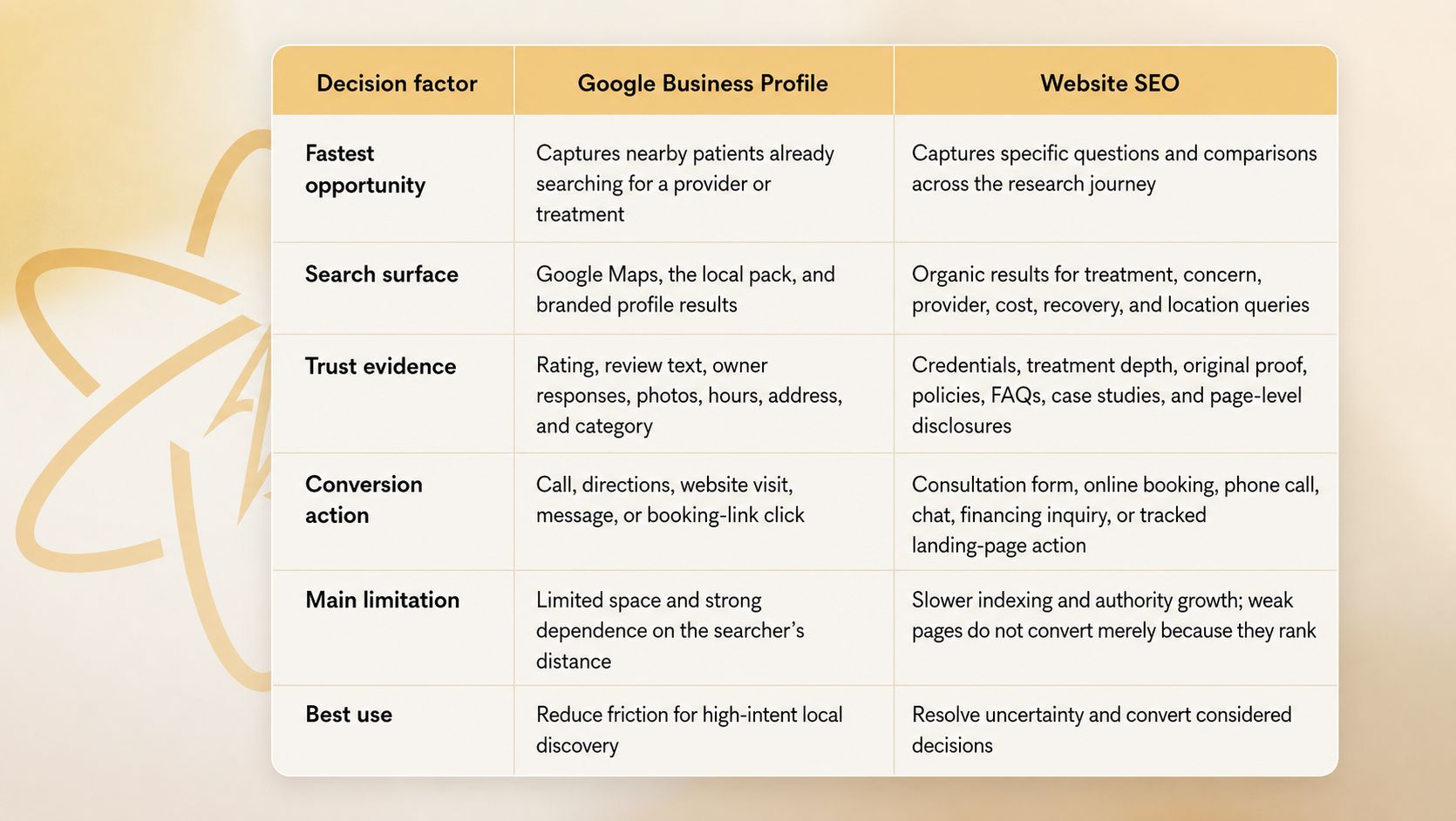
The table is not a budget argument for choosing one channel. It is a handoff map. The profile earns the next click; the website earns the informed booking.
What should an aesthetic practice optimize first?
An aesthetic practice should optimize the point where qualified demand is currently leaking. Use this sequence:
- Fix profile accuracy first. Confirm ownership, primary and secondary categories, name, address, phone, hours, services, appointment URL, photos, and duplicate listings.
- Fix the landing path. Send high-intent visitors to the most relevant treatment or location page, not automatically to the homepage.
- Build decision pages. Cover treatment process, candidacy, provider, cost factors, recovery, risks, alternatives, FAQs, and the next step with appropriate clinical review.
- Align entities. Keep the practice name, provider names, credentials, address, phone number, and service names consistent across the profile, website, booking platform, and authoritative directories.
- Measure bookings by source. Use profile performance data, tagged booking links, call tracking configured with a consistent primary number, analytics events, CRM source fields, and completed-appointment reporting.
The Aestheticians Digital 360 growth framework combines local SEO, Google Maps visibility, conversion UI/UX, CRM integration, and treatment-specific landing pages.
Its published aesthetic marketing case studies include a local SEO and Google Maps patient-acquisition program for a med spa, making that example the most relevant proof for this topic.
.png)
How should different cosmetic practices apply the strategy?
The same channel model needs specialty-specific execution. Marketing for independent aestheticians may emphasize hyperlocal discovery, signature services, availability, and repeat-care pathways.
Cosmetic dental marketing requires deeper pages for procedure comparisons, treatment stages, and financial questions.
Dermatology marketing must connect local visibility with clear provider and service information.
Plastic surgery marketing usually carries a longer research journey, so provider pages, procedure depth, consultation expectations, and compliant proof deserve greater weight.
In every specialty, the profile and the site should use the same facts and lead to the same next step.
Frequently asked questions
.png)
Which channel should your practice fund first?
Fund Google Business Profile cleanup first when demand exists but the listing is inaccurate, incomplete, or difficult to book from. Fund website SEO first when patients find the practice but cannot evaluate its treatments, providers, proof, or next step.
Most practices need a coordinated plan that closes both gaps.
Aestheticians Digital builds patient-acquisition systems specifically for aesthetic and cosmetic practices.
Explore the aesthetic practice marketing approach, then request a search-to-booking visibility assessment to identify whether your profile, website, or the handoff between them is losing the next qualified appointment.
Google Business Profile usually produces the faster first lift for nearby, ready-to-book searches, while website SEO builds the stronger long-term booking engine.
The reason is simple: the profile shortens the path from “near me” search to call, directions, or booking, but the website answers the clinical, financial, and trust questions that often decide whether a patient converts.
Key takeaways
- Google Business Profile is the faster priority when your listing is incomplete, poorly categorized, inconsistent, or missing a direct booking path.
- Website SEO becomes decisive when patients compare treatments, providers, credentials, recovery, cost factors, candidacy, and evidence before contacting a practice.
- Google evaluates local results mainly through relevance, distance, and prominence, so neither channel can control every search.
- A profile can introduce the practice; treatment pages, provider pages, proof, and conversion design must finish the decision.
- The right KPI is not rankings alone. Track qualified calls, booking-link actions, form submissions, scheduled consultations, and completed visits by source.
Does Google Business Profile or website SEO get bookings faster?
Google Business Profile usually gets local practices booked faster when demand exists and the listing has obvious gaps.
Correct categories, services, hours, photos, reviews, appointment links, and location data can improve its match for searches such as “med spa near me” or “cosmetic dentist open Saturday.”
Google states that local visibility is mainly based on relevance, distance, and prominence. Complete business information supports relevance, but optimization cannot override a searcher’s location. Review quality and links from other websites can also contribute to prominence.
That is why a profile may gain calls quickly in one part of a city yet remain less visible several miles away. See Google’s official explanation of local ranking factors for Google Business Profile.
Website SEO typically takes longer because Google must crawl and evaluate multiple pages. It also creates more entry points.
A site can rank for treatment, concern, comparison, cost, recovery, provider, and location queries that a profile cannot explain properly. For an early timeline, review what to expect from med spa SEO in the first 90 days.
Why can a Google Business Profile generate calls but still fail to generate qualified patients?
A Google Business Profile can generate calls without generating qualified patients because its compact format leaves major decision questions unanswered.
A person may find the practice in Maps but still need to confirm who performs the procedure, whether the provider treats their concern, what the consultation includes, how pricing is determined, and what happens next.
That gap is costly for services such as facial surgery, body contouring, laser plans, cosmetic dentistry, and multi-session packages. A generic homepage makes patients hunt for answers. A focused treatment or location page reduces friction.
Reviews matter, but they cannot replace structured service information, provider credentials, original photos, policies, FAQs, or a clear booking route.
The Federal Trade Commission’s consumer reviews and testimonials guidance also prohibits fake or false reviews and certain sentiment-conditioned incentives. A sustainable review program asks real patients for honest feedback and never treats ratings as the entire trust strategy.
That distinction is explored further in why Google reviews are no longer enough for med spas.
When does website SEO outperform Google Business Profile?
Website SEO outperforms Google Business Profile when the query requires explanation, comparison, or evidence. A prospective patient asking “microneedling versus laser resurfacing for acne scars” needs more than a map listing.
A prospective implant or veneer patient may compare cost factors, treatment stages, financing, provider experience, and expected maintenance before making contact.
Your website can create a dedicated, indexable answer for each decision stage:
- Service pages explain what the treatment is, who may be a candidate, what the process involves, and the next step.
- Provider pages establish identity, credentials, specialty, and relevant experience without unsupported claims.
- Location pages connect the practice to a real office, service area, directions, parking, and local proof.
- FAQs answer one specific question at a time in language patients use with Google and AI assistants.
- Case studies and approved before-and-after material demonstrate context, not guarantees.
- Booking pages preserve message continuity from the search query to the requested appointment.
Google’s LocalBusiness structured-data documentation explains how a website can identify business details for Search. Markup supports understanding, but it does not replace visible page content or guarantee a rich result.
Google Business Profile vs. website SEO: what does each channel do best?
The table is not a budget argument for choosing one channel. It is a handoff map. The profile earns the next click; the website earns the informed booking.
What should an aesthetic practice optimize first?
An aesthetic practice should optimize the point where qualified demand is currently leaking. Use this sequence:
- Fix profile accuracy first. Confirm ownership, primary and secondary categories, name, address, phone, hours, services, appointment URL, photos, and duplicate listings.
- Fix the landing path. Send high-intent visitors to the most relevant treatment or location page, not automatically to the homepage.
- Build decision pages. Cover treatment process, candidacy, provider, cost factors, recovery, risks, alternatives, FAQs, and the next step with appropriate clinical review.
- Align entities. Keep the practice name, provider names, credentials, address, phone number, and service names consistent across the profile, website, booking platform, and authoritative directories.
- Measure bookings by source. Use profile performance data, tagged booking links, call tracking configured with a consistent primary number, analytics events, CRM source fields, and completed-appointment reporting.
The Aestheticians Digital 360 growth framework combines local SEO, Google Maps visibility, conversion UI/UX, CRM integration, and treatment-specific landing pages.
Its published aesthetic marketing case studies include a local SEO and Google Maps patient-acquisition program for a med spa, making that example the most relevant proof for this topic.
How should different cosmetic practices apply the strategy?
The same channel model needs specialty-specific execution. Marketing for independent aestheticians may emphasize hyperlocal discovery, signature services, availability, and repeat-care pathways.
Cosmetic dental marketing requires deeper pages for procedure comparisons, treatment stages, and financial questions.
Dermatology marketing must connect local visibility with clear provider and service information.
Plastic surgery marketing usually carries a longer research journey, so provider pages, procedure depth, consultation expectations, and compliant proof deserve greater weight.
In every specialty, the profile and the site should use the same facts and lead to the same next step.
Frequently asked questions
Which channel should your practice fund first?
Fund Google Business Profile cleanup first when demand exists but the listing is inaccurate, incomplete, or difficult to book from. Fund website SEO first when patients find the practice but cannot evaluate its treatments, providers, proof, or next step.
Most practices need a coordinated plan that closes both gaps.
Aestheticians Digital builds patient-acquisition systems specifically for aesthetic and cosmetic practices.
Explore the aesthetic practice marketing approach, then request a search-to-booking visibility assessment to identify whether your profile, website, or the handoff between them is losing the next qualified appointment.

At Aestheticians Digital, big ideas deserve bold execution.
Table of Content
Get insghts that drive results.
Contact us for strategy, design tips, and industry insights—straight to your inbox.
.svg)
.svg)
MEET THE AUTORS


© Copyright 2026 | Design & Developed By Aesthetics Digital LLC.